An Introduction to Diversification.
Michaelangelo Aboyade-Cole

When it comes to investing, one of the most important strategies to ensure long-term success is diversification. But what exactly does diversification mean, and why is it so crucial? Diversification serves as a means to spread risk across different investments so that you are not overly exposed to any single asset. As the saying goes, "Don't put all your eggs in one basket." What is risk? There are several different kinds of risk you face as an investor. The first and classical definition of investment risk is volatility. This is the kind of risk we try to diversify away by choosing investments that are not highly correlated with each other, so that if one of our investments is going down, the others may be going up or at least not going down as much. Other kinds of risks our portfolio may face include geographic risks. For instance, if we have a high concentration of our portfolio in a specific country and war or internal conflict breaks out, this could affect a large portion of our holdings. Another example is industry risk: the dot-com bubble saw most technology stocks crash in a short period of time, meaning that if you were overexposed to tech stocks, your net worth could have been wiped out. There are also additional risks related to the attributes of an investment, such as inflation risk, interest rate risk, currency risk, and political or regulatory risks. All of these can pose potential catastrophes for your portfolio if it is overexposed. We mitigate these risks by diversifying across different regions, industries, and asset types.
In essence, it is a way to avoid putting all your eggs in one basket. Whether you are a seasoned investor or just starting, understanding diversification and its role in mitigating risk can help safeguard your investments, especially in a volatile market.
The Purpose of Diversification
At its core, the purpose of diversification is simple: reduce risk without necessarily reducing returns. Every investment carries an intrinsic level of risk, but by combining different types of assets, investors can smooth out the volatility in their portfolios. If one asset class or industry suffers a downturn, the losses may be offset by the better performance of another.
There are two main types of risks in investing:
1. Systematic Risk (Market Risk): This refers to the risk that affects the entire market. For example, the 2020 Covid pandemic recession caused a general decline in the stock market. Diversification can't fully eliminate systematic risk because it impacts all sectors and assets.
2. Unsystematic Risk (Idiosyncratic Risk): This is the risk that is unique to a particular company, industry or geographic region. Diversifying your portfolio by holding stocks in multiple companies, across various industries or in various geographic locations, can reduce or eliminate this type of risk.
By holding a diversified portfolio, you are protecting yourself from the unpredictable nature of financial markets. While no strategy can completely eliminate risk, diversification is widely considered to be one of the most effective ways to minimize it.
Examples of Diversification
Let's explore a simple example: imagine an investor, Tom, who holds only technology stocks. If the tech industry faces a downturn — perhaps due to new regulations — the entire portfolio will suffer. On the other hand, an investor, Edwin, who holds stocks in multiple sectors such as utilities, alongside tech stocks, will likely experience less volatility. While the tech stocks may decline, the utilities sector may perform well, helping to offset the potential losses.
Another example is geographic diversification. If all of an investor's holdings are in a single country, say Mali, they are exposed to country-specific risks like economic slowdowns or political instability. Investing in international markets, like Europe or Asia, helps spread risk across different economies, each of which may respond differently to global events.
Diversification can extend beyond just stocks. A well-diversified portfolio may include a variety of asset classes, such as:
1. Bonds which are generally less volatile than stocks.
2. Real Estate which provide returns that often move independently of the stock market.
3. Commodities, such as gold or oil, which may perform well during inflationary periods.
4. Cryptocurrencies, such as Bitcoin, Ethereum and Solana are an entirely different asset class than stocks and have had historically low correlation with traditional assets as a whole. This is changing in recent times because of increased institutional participation and macroeconomic trends. Nonetheless, cryptocurrencies provide a nice form of diversification to a portfolio as they give exposure to emerging technologies.
Benefits of Diversification
1. Risk Reduction: Diversification lowers portfolio risk by spreading investments across different assets and industries, which helps reduce volatility when some investments perform poorly while others may do well. This strategy creates more stable returns by balancing the fluctuations in market performance.
2. Protection Against Unforeseen Events: Diversification across asset classes, sectors, and regions helps protect portfolios from the unpredictable impacts of events like financial crises or natural disasters. This strategy acts as a safety net, reducing the effect of any single event and helping investors manage economic downturns. Diversification strengthens your returns due the power of not losing money. If you lose 50% of your initial investments, you thereafter need to gain 100% return (double) to maintain the same portfolio value.
3. Potential for Optimized Returns: Diversification not only reduces risk but also enhances long-term returns by exposing your portfolio to various sectors and asset classes that may perform well at different times. This strategy allows you to capture growth opportunities across a broad spectrum of investments, optimizing long-term growth without concentrating risk in a single area.
In summary, diversification is a key component of any successful investment strategy. It serves to minimize the risk of significant losses by ensuring that your investments are spread across a variety of assets, sectors, and regions. By doing so, you can safeguard against market downturns, while still positioning yourself to take advantage of growth opportunities.
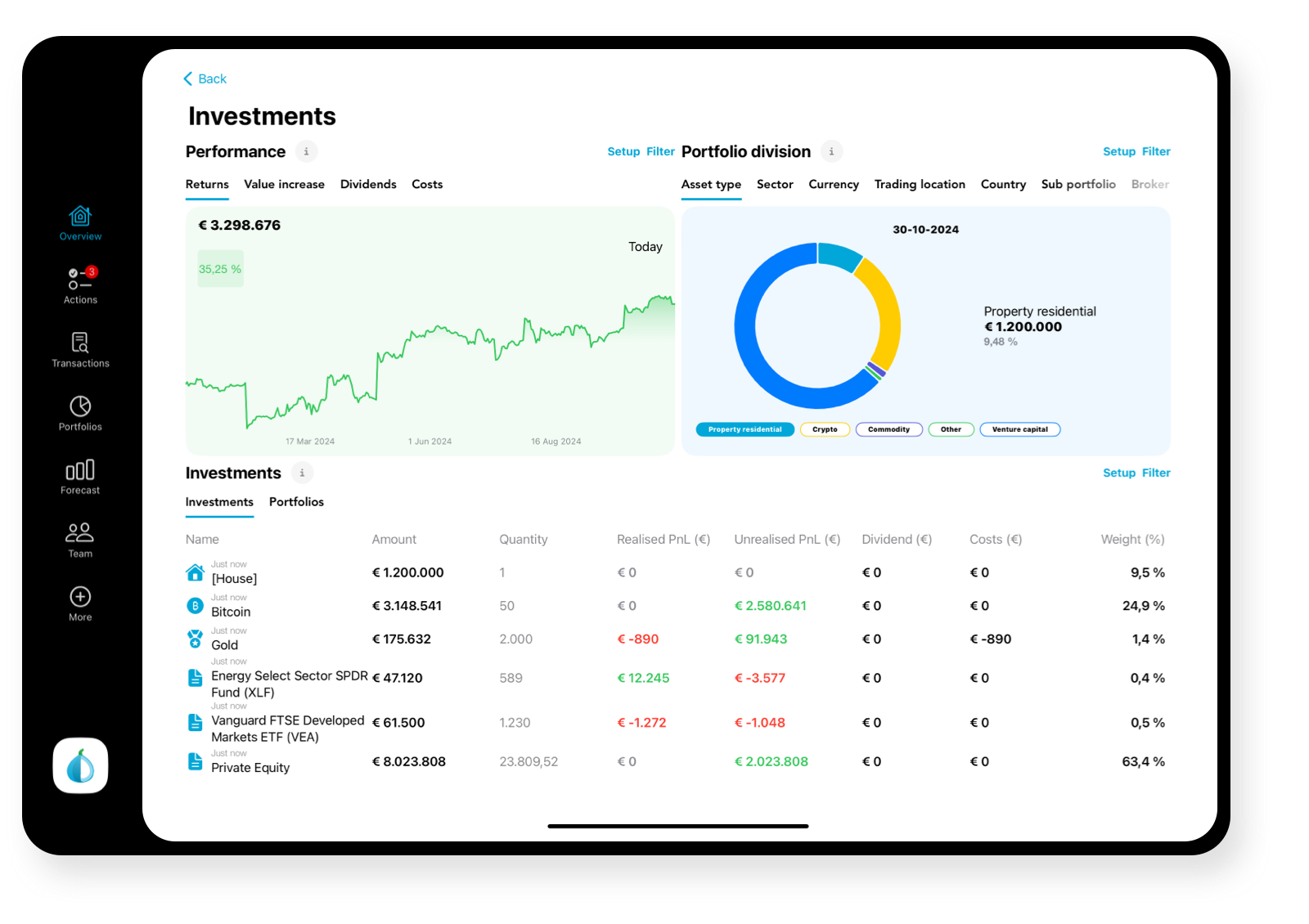
With the Figy app, monitoring your exact portfolio components and the diversification of all your assets has never been easier. You can easily track the performance of each investment or portfolio, unrealised and realised profits and losses, as well as the costs associated with each asset. You can filter them by asset type (obviously), sector, currency (did anyone say exchange rate risk?), and trading location (geographical diversification successfully monitored). Regardless of the composition of your portfolio and your diversification strategy, Figy is here for you.
In the next part of this series, we'll delve deeper into the mathematics behind diversification, exploring how correlation and variance help quantify the benefits of spreading risk across different investments. In the third part of this series, we will expand upon the common strategies behind diversification.
Important Note: This article does not constitute financial advice. Please consult a professional for financial guidance.
Glossary
Asset Classes
Categories of investments with similar characteristics. Common asset classes include stocks, bonds, real estate, commodities, and cash.
Bonds
Fixed-income securities representing loans made by an investor to a borrower, usually corporate or governmental.
Commodities
Raw materials or primary agricultural products, such as gold, oil, or wheat, that can be bought and sold.
Correlation
A statistical measure of how two asset prices move in relation to each other.
Cryptocurrencies
Digital or virtual currencies that use cryptography for security, such as Bitcoin or Ethereum.
Diversification
A strategy that spreads investments across various asset classes, sectors, or geographic regions to reduce risk.
Geographic Diversification
Spreading investments across different countries or regions to reduce exposure to country-specific risks.
Idiosyncratic Risk
The risk associated with a specific company, industry, or sector, which can be reduced through diversification.
Institutional Participation
Refers to the involvement of large financial organizations in markets, such as banks or pension funds.
Macroeconomic Trends
Large-scale economic factors or changes that affect markets as a whole, such as inflation, interest rates, or economic growth.
Portfolio Allocation
The process of dividing a portfolio among different asset classes to balance risk and potential returns.
Real Estate
Property, including land and buildings, used as an investment to generate returns.
Returns Optimisation
The process of adjusting a portfolio to achieve the highest possible returns for a given level of risk.
Risk Reduction
A strategy aimed at lowering the overall risk of a portfolio, often by diversifying investments.
Systematic Risk
The risk that affects the entire market or a large segment of it, such as economic recessions.
Unsystematic Risk
The risk specific to a single company or industry, such as a corporate scandal or regulatory changes.
Volatility
A statistical measure of the degree of variation in the price of an asset over time.